- Don't criticize Barack Obama over anything that's happening in America, because it turns out all real domestic power lies in the hands of the House of Representatives, not the president.
- Don't criticize Barack Obama's foreign policy because that will only depress his base and help Mitt Romney, who would probably be just as belligerent (unless you believe the Democratic Party). And my god, have you seen Romney's domestic policies (editor's note: obviously, ignore point #1 when speaking of Republicans)?
- Don't criticize Barack Obama.
Wednesday, May 30, 2012
Rules for reformists
With the 2012 U.S. presidential election coming up, here are some helpful rules for discussion that I have gleaned from liberals online:


Monday, May 28, 2012
Dana Rohrabacher: Lying now or then?
Back in 2002, California Republican Dana Rohrabacher was an outspoken advocate of invading Iraq, the sort that claimed it was improper to even label the impending invasion a "war" because it was really more of a liberation, one for which the Iraqi people would be so grateful they'd be "dancing in the streets waving American flags just as the people of Afghanistan still are grateful to us for freeing them." When that gratitude predictably failed to materialize -- it's hard to really let loose and celebrate when you're busy making funeral arrangements for family members liberated from their corporeal existence -- Rohrabacher, rather than engage in any sort of self-reflection, labeled Iraqis ungrateful and famously demanded they foot the bill for the destruction of their country.
Nowadays, Rohrabacher is busy revising his pre-war stance in an effort to make him look less like a dishonest warmonger. On Twitter, he confesses that he never really believed all that malarkey about weapons of mass destruction and existential threats to America's consumerist way of life. Not at all! His support for a war that directly killed upwards of 150,000 Iraqi civilians was all about Freedom, he says:
 And, in case that wasn't clear enough:
 Except, gosh -- and this is the kicker -- he didn't let the American people in on his little secret back before the war started. When it mattered. Here is Rohrabacher on the floor of the House of Representatives back in October 2002:
Update: The congressman answers:

Translation: I don't deny that I lied before Congress and the American public in a major floor speech on the eve of a decision to go to war. But other times I didn't!
Nowadays, Rohrabacher is busy revising his pre-war stance in an effort to make him look less like a dishonest warmonger. On Twitter, he confesses that he never really believed all that malarkey about weapons of mass destruction and existential threats to America's consumerist way of life. Not at all! His support for a war that directly killed upwards of 150,000 Iraqi civilians was all about Freedom, he says:
We're not declaring war on Iraq. We are declaring that Saddam Hussein must go. And Saddam Hussein must go for the sake of the people of Iraq and for the sake of the safety of our people. And let me note this, rebuilding Iraq will be much easier than building Afghanistan. Iraq has enormous resources that have been channeled away by Saddam Hussein to develop chemical and biological weapons and to develop nuclear weapons. Those billions of dollars can be put to use to build a better Iraq. And the people will applaud us for helping them with that end. No, this is much easier than the job in Afghanistan. Yet we have the naysayers among us who would lead us in the other direction.So the question is, congressman: Were you lying then or are you lying now?
Update: The congressman answers:
Translation: I don't deny that I lied before Congress and the American public in a major floor speech on the eve of a decision to go to war. But other times I didn't!
Killing by remote control
Under George W. Bush, it was an Outrage! that the U.S. government was indefinitely imprisoning poor, innocent foreigners without so much as charging them with a crime. Under Barack Obama, killing poor, innocent foreigners without so much as charging them with a crime is now a mark of a Successful Foreign Policy, showing the president has the cojones to authorize mass murder based on an international stop and drone strike policy of profiling.
For the better part of four kind of depressing months, I returned to my old imperial stomping grounds in Washington, DC, to help research and write a book with Code Pink's Medea Benjamin on this new form of remote-controlled war, which has dramatically expanded under the Nobel-laureate-in-chief, killing hundreds if not thousands of innocent people in Afghanistan, Pakistan, Yemen and Somalia (turns out precision isn't such a grand thing when you have no idea who precisely you're targeting). As Medea and I show, drones are not the revolutionary, life-saving tools they have been sold as to the American public, but merely the latest evolution of inherently indiscriminate air warfare, one that threatens to make war more sanitary for television audiences but no less bloody for the faultless men, women and children who always bear the brunt of state-sanctioned violence.
Buy it or find a torrent or something.
For the better part of four kind of depressing months, I returned to my old imperial stomping grounds in Washington, DC, to help research and write a book with Code Pink's Medea Benjamin on this new form of remote-controlled war, which has dramatically expanded under the Nobel-laureate-in-chief, killing hundreds if not thousands of innocent people in Afghanistan, Pakistan, Yemen and Somalia (turns out precision isn't such a grand thing when you have no idea who precisely you're targeting). As Medea and I show, drones are not the revolutionary, life-saving tools they have been sold as to the American public, but merely the latest evolution of inherently indiscriminate air warfare, one that threatens to make war more sanitary for television audiences but no less bloody for the faultless men, women and children who always bear the brunt of state-sanctioned violence.
Buy it or find a torrent or something.
Saturday, May 26, 2012
Monday, May 21, 2012
Fool me once
Angry Black Lady, the would-be MSNBC contributor who currently blogs for the extremely credible website The Raw Story -- after a career as a lawyer specializing in business and foreclosure litigation on behalf of underprivileged clients like J.P. Morgan Chase and Lloyd's of London -- writing back in March 2011 on the treatment of accused whistle-blower Bradley Manning:
Meanwhile, the United Nations' special rapporteur on torture, Juan Mendez, writes in a report released March 2012 after a 14-month investigation that:
Clearly, those concerned about Manning's treatment back in March 2011, be they lawyers or activists or concerned citizens of the world, were not "being grifted," in the words of an executive director of a Political Action Committee. Prolonged solitary confinement is just as much torture as water boarding, destroying a person's sense of self worth and, in some cases, their mind. Were George W. Bush still president it's doubtful liberals would invest so much time in denying that in favor of attacks on the alleged whistle-blower.
But back to ABL. Now, a year after some privileged fool had the nerve to bring up past things she has asserted:
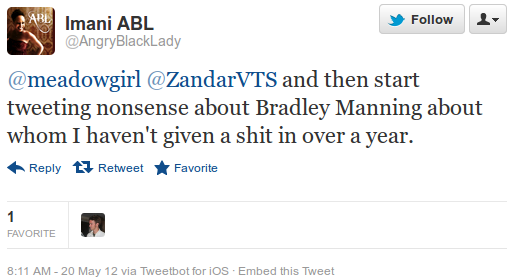 Funny how that works. After initially feigning concern about evils like torture or indefinite detention, ABL then proceeds to denying that there's any reason to be concerned about Barack Obama's role in perpetuating them. Then, after declaring that there's nothing to see here, folks, move along, she then later adopts a pose of disinterested superiority when confronted with inconvenient facts, like a federal judge ruling that American activists did in fact have legitimate fears they could be imprisoned forever under the National Defense Authorization Act (NDAA) signed by Obama or the UN special rapporteur on torture declaring that Manning's extended time in solitary confinement likely violated international conventions against torture.
At other times, she just decides to ignore past expressions of concern in favor of full-throated support for whatever its Obama is doing. For instance, when Zaid Jilani, at the time with that bastion anti-Obama hackery the Center for American Progress, argued ABL ignores Obama's bombing of poor brown people all because she studiously ignores Obama's bombing of poor brown people – and mocks as unserious, privileged “emoprogs” those – she responded, hurt, that, “Of course I don’t favor bombing brown people.” It's just that not bombing poor brown people must be “balanced against all else that a president must accomplish before an idea becomes reality.” You know what's coming. About six months later, ABL published a post by a guest blogger accusing New York Times reporter Charlie Savage – author of the 2007 book, Takeover: The Return of the Imperial Presidency & the Subversion of American Democracy – of carrying out a “partisan hit job on President Obama.” His offense: suggesting Obama's unilateral decision to bomb Libya was at odds with a campaign-trail assertion that he would not bomb a country that did not pose an immediate threat without first consulting Congress.
Not fair! Savage “omits . . . the part that narrowly ties [the question posted to Obama] to the circumstances of a preemptive war to stop alleged WMD production where the U.S. is under no imminent threat.” But Libya wasn't even accused of WMD production is the no-really, not-joking objection. And anyway, “the theory of executive power that Savage is holding Obama up against is a discredited libertarian notion of weak executive power shared by Ron Paul and Glenn Greenwald views which have no support in constitutional law jurisprudence." And that reveals ABL and her cadre's perhaps favorite debate technique: when not mocking anyone who objects to Our President's unilateral wars or assassinations as blinded by privilege -- it takes a former lawyer for J.P. Morgan to spot it -- she invariably accuses those who think we should still talk about things like war and peace when a Democrat's in the White House of being little more than Ron Paul or Glenn Greenwald fanboys, just as some conservatives seek to tie any concerns about income inequality to Vladamir Lenin; it's easier to attack a flawed human being than an idea. It doesn't matter if you always objected to extrajudicial executions or unjust wars of aggression, it matters if you object to them under Obama. Because you know who else objects to things Obama does? Racists.
Not content just publishing pro-unilateral war diatribes, ABL -- when not claiming offense after someone points it out -- regularly makes her disregard for foreign life explicit on Twitter, with cute little posts like this:
 I don't know about you, but I'm sure glad ABL's career representing some of the largest banks and insurers in the world has afforded her the privilege to contribute to the public discourse by way of opining all day on Twitter. Finally we have a corporate lawyer willing to stand up for power and call out the truly privileged: those who think the existence of the Republican Party does not detract from the fact that killing poor foreigners with Hellfire missiles and cluster bombs is wrong.
Update: The original version of this piece said the post on Charlie Savage was "by ABL," because that's what it says. On Twitter, she says she merely published it.

I’m going to wait for some facts, if you don’t mind. And don’t sit here and snark at me about how I’m uncomfortable with the word torture. If it turns out Manning is being tortured, then I’ll happily take up that cause. But thus far, the reporting has been shoddy and bullshit and an appeal to emotion. There is no evidence that Manning’s treatment is torture . . . . Again, there is no righteousness in your position because you don’t know SHIT. If it turns out you’re not being grifted, then I’ll owe you an apology. But for now fuck off and take your self-righteousness back to the Lake where you belong. Leave the critical thinking to those of us who have the capability.What's happened since then? Well, in April 2011 more than 250 legal experts, including Harvard University's Lawrence Tribe, "considered to be America's foremost liberal authority on constitutional law," signed a letter that called Manning's detention both "degrading and inhumane," as well as "illegal and immoral." That detention entailed Manning spending 23-hours-a-day in solitary confinement, a technique that Craig Haney of the University of California, Santa Cruz, notes has "been used to torture prisoners of war."
Meanwhile, the United Nations' special rapporteur on torture, Juan Mendez, writes in a report released March 2012 after a 14-month investigation that:
"[I]mposing seriously punitive conditions of detention on someone who has not been found guilty of any crime is a violation of his right to physical and psychological integrity as well as of his presumption of innocence."In addition, Mendez noted:
"[S]olitary confinement is a harsh measure which may cause serious psychological and physiological adverse effects on individuals regardless of their specific conditions." Moreover, "[d]epending on the specific reason for its application, conditions, length, effects and other circumstances, solitary confinement can amount to a breach of article seven of the international covenant on civil and political rights, and to an act defined in article one or article 16 of the convention against torture."Mendez has called for a ban on all solitary confinement lasting more than 15 days, noting that the United States is one of the most frequent employers of the technique, using it against at least 20,000 of the country's more than 2.3 million prisoners every day. Manning's time in solitary confinement, for reference, was more than nine months.
Clearly, those concerned about Manning's treatment back in March 2011, be they lawyers or activists or concerned citizens of the world, were not "being grifted," in the words of an executive director of a Political Action Committee. Prolonged solitary confinement is just as much torture as water boarding, destroying a person's sense of self worth and, in some cases, their mind. Were George W. Bush still president it's doubtful liberals would invest so much time in denying that in favor of attacks on the alleged whistle-blower.
But back to ABL. Now, a year after some privileged fool had the nerve to bring up past things she has asserted:
At other times, she just decides to ignore past expressions of concern in favor of full-throated support for whatever its Obama is doing. For instance, when Zaid Jilani, at the time with that bastion anti-Obama hackery the Center for American Progress, argued ABL ignores Obama's bombing of poor brown people all because she studiously ignores Obama's bombing of poor brown people – and mocks as unserious, privileged “emoprogs” those – she responded, hurt, that, “Of course I don’t favor bombing brown people.” It's just that not bombing poor brown people must be “balanced against all else that a president must accomplish before an idea becomes reality.” You know what's coming. About six months later, ABL published a post by a guest blogger accusing New York Times reporter Charlie Savage – author of the 2007 book, Takeover: The Return of the Imperial Presidency & the Subversion of American Democracy – of carrying out a “partisan hit job on President Obama.” His offense: suggesting Obama's unilateral decision to bomb Libya was at odds with a campaign-trail assertion that he would not bomb a country that did not pose an immediate threat without first consulting Congress.
Not fair! Savage “omits . . . the part that narrowly ties [the question posted to Obama] to the circumstances of a preemptive war to stop alleged WMD production where the U.S. is under no imminent threat.” But Libya wasn't even accused of WMD production is the no-really, not-joking objection. And anyway, “the theory of executive power that Savage is holding Obama up against is a discredited libertarian notion of weak executive power shared by Ron Paul and Glenn Greenwald views which have no support in constitutional law jurisprudence." And that reveals ABL and her cadre's perhaps favorite debate technique: when not mocking anyone who objects to Our President's unilateral wars or assassinations as blinded by privilege -- it takes a former lawyer for J.P. Morgan to spot it -- she invariably accuses those who think we should still talk about things like war and peace when a Democrat's in the White House of being little more than Ron Paul or Glenn Greenwald fanboys, just as some conservatives seek to tie any concerns about income inequality to Vladamir Lenin; it's easier to attack a flawed human being than an idea. It doesn't matter if you always objected to extrajudicial executions or unjust wars of aggression, it matters if you object to them under Obama. Because you know who else objects to things Obama does? Racists.
Not content just publishing pro-unilateral war diatribes, ABL -- when not claiming offense after someone points it out -- regularly makes her disregard for foreign life explicit on Twitter, with cute little posts like this:
Update: The original version of this piece said the post on Charlie Savage was "by ABL," because that's what it says. On Twitter, she says she merely published it.
Saturday, May 19, 2012
Thursday, May 17, 2012
Prison rape is no joke
As pundits and politicians fill the airwaves with talk of poll numbers and campaign strategies, there's a genuine epidemic of rape going on in the United States among the most marginalized segment of American society: the nation's more than 2.3 million incarcerated men, women and children.
According to a new survey conducted by the U.S. Department of Justice, one in 10 people formerly imprisoned in a state cage reported that they were sexually abused during their most recent stint behind bars. LGBT inmates are abused the worst, 39 percent of gay male prisoners telling investigators they were assaulted by their fellow inmates.
But it wasn't just prisoners who were doing the assaulting, but -- can you believe it? -- the paid enforcers of state violence who are paid to daily dehumanize the chattel before them. Just Detention International, an organization which seeks to draw attention to the sexual assault of prisoners, notes in a press release that nearly a third of all prisoners "reported staff sexual harassment during showers and searches while undressing -- harassment that did not meet the Department of Justice's threshold for sexual abuse." Meanwhile, nearly half of those who were sexually abused by DOJ standards and "reported to a corrections official that they had been sexually abused by a staff member were themselves written up for an infraction." Inmates also reported that they were just as likely to be punished for reporting prisoner-on-prisoner abuse as they were to get the opportunity to speak to an investigator. More than a third said "facility staff did not respond at all."
"With such blatant retaliation for reporting abuse, it’s no wonder the vast majority of prisoner rape survivors choose to remain silent,” says Lovisa Stannow, JDI's executive director. The report "reaffirms the crisis of sexual abuse in U.S. detention, and of the government’s utter failure to protect people in its custody."
If you want evidence of a war on women and other living things, don't just pay attention to the formal goings-on in state legislatures -- look at the prisons and their hundreds of thousands of inhabitants. And keep in mind this depressing thought: that war is condoned by a bipartisan majority of politicians as well as a mainstream culture that thinks prison rape is more material for a stand-up routine than an appalling shock to one's humanity. The federal standard announced by DOJ to address this epidemic is welcome, but as the survey suggests: it's all in how the rules are enforced.
According to a new survey conducted by the U.S. Department of Justice, one in 10 people formerly imprisoned in a state cage reported that they were sexually abused during their most recent stint behind bars. LGBT inmates are abused the worst, 39 percent of gay male prisoners telling investigators they were assaulted by their fellow inmates.
But it wasn't just prisoners who were doing the assaulting, but -- can you believe it? -- the paid enforcers of state violence who are paid to daily dehumanize the chattel before them. Just Detention International, an organization which seeks to draw attention to the sexual assault of prisoners, notes in a press release that nearly a third of all prisoners "reported staff sexual harassment during showers and searches while undressing -- harassment that did not meet the Department of Justice's threshold for sexual abuse." Meanwhile, nearly half of those who were sexually abused by DOJ standards and "reported to a corrections official that they had been sexually abused by a staff member were themselves written up for an infraction." Inmates also reported that they were just as likely to be punished for reporting prisoner-on-prisoner abuse as they were to get the opportunity to speak to an investigator. More than a third said "facility staff did not respond at all."
"With such blatant retaliation for reporting abuse, it’s no wonder the vast majority of prisoner rape survivors choose to remain silent,” says Lovisa Stannow, JDI's executive director. The report "reaffirms the crisis of sexual abuse in U.S. detention, and of the government’s utter failure to protect people in its custody."
If you want evidence of a war on women and other living things, don't just pay attention to the formal goings-on in state legislatures -- look at the prisons and their hundreds of thousands of inhabitants. And keep in mind this depressing thought: that war is condoned by a bipartisan majority of politicians as well as a mainstream culture that thinks prison rape is more material for a stand-up routine than an appalling shock to one's humanity. The federal standard announced by DOJ to address this epidemic is welcome, but as the survey suggests: it's all in how the rules are enforced.
Twit story
First I was like:

But then a federal judge appointed by Barack Obama ruled that under the NDAA, "it is certainly the case that if plaintiffs were detained as a result of their conduct, they could be detained until the cessation of hostilities - i.e., an indeterminate period of time," and I was like:
 And because I wanted to regain my smug sense of superiority by courageously debating a straw person:
 Because, probably, only two people have ever been indefinitely imprisoned by the United States. And they were, probably, some WHITE DOODS, right?

But then a federal judge appointed by Barack Obama ruled that under the NDAA, "it is certainly the case that if plaintiffs were detained as a result of their conduct, they could be detained until the cessation of hostilities - i.e., an indeterminate period of time," and I was like:


Monday, May 14, 2012
Education and social revolution
San Diego is a great place. As a college student, I had a lot of fun there. But it's an inescapable, lamentable fact that the whole county is basically just one big military base with a few recreational areas scattered here and there, everyone from Lockheed-Martin to the Marines having decided to set up shop in Southern California. Walk down Pacific Beach's Garnet Avenue at 2am on a Saturday morning -- hypothetically, of course -- and the soldier-to-frat-boy ratio is usually 1:1; private contractors prefer the Gaslamp District. That's why it's encouraging that students at Mission Beach High School were able to successfully drive the military and their JROTC recruiting program off their campus: if they can do it there, it shows its possible to do it anywhere.
 But if their victory is to be replicated elsewhere, it's important to keep in mind the tactics that were employed, most of all that the students didn't win by appealing to authority, but by subverting it. Knowing that the school board and principal who lobbied to bring the military to their school -- along with an on-campus shooting range -- would never turn around and kick them off, the students appealed to their fellow students, speaking directly to the people the Pentagon was trying to recruit. As the Committee Opposed to Militarism and the Draft notes in a writeup about the victory, the "most important factor in the success . . . was the students themselves, who persevered even when their principal and others tried to silence and intimidate them."
Outside activists helped spread the word about the students' struggle within the school by handing out leaflets outside, the committee notes, but the "most significant work was done over a long period inside. Through peer education, the students were able to reverse the 'coolness' equation so that rejecting the lure of JROTC became more legitimate than joining it. Once that happened, a de facto boycott of the program ensued that made it impossible to sustain JROTC."
Ultimately, the JROTC program ended at Mission Beach HS not because the principal caved to the pressure of a letter-writing campaign or online petition, but because the students convinced their peers that they should simply refuse to be recruited, handing out buttons declaring they were "Students Not Soldiers” and “Yo No Soy El Army”. Only because the number of students enrolled for the 2011-2012 school year was less than half the 100 required by law to keep it open and justify the expense of employing two full-time instructors was the recruiting program canceled.
Again: this was in San Diego. As a high school student in the Philly suburbs, I couldn't imagine an anti-recruiting campaign succeeding at my school, where muscular recruiters would set up their propaganda shop in the cafeteria and be fawned over as bad-ass heroes by 14 year olds (thank goodness they were just selling militarism, not cigarettes). But these students succeeded in the heart of imperial beast. Pretty impressive.
There's a lesson in this tale for more than just anti-ROTC activists and counter-recruiters. Meaningful change can't be imposed from the top down as effectively as it can from the bottom up. In order to create that anarcho-topia where the radical notion that it's widely accepted as socially unacceptable to put millions of people in cages or bomb and starve millions of others abroad, a society needs to go through a social revolution, not a mere political one. You don't end war by encouraging a parliament to pass a resolution, or by swapping politicians and governing forms, but by creating a culture that finds blowing innocent men, women and children to bits as abhorrent as pushing an old lady into oncoming traffic. Those in power can't start wars if they don't find anybody willing to fight them.
Now, a social revolution isn't any easy to thing to pull off. Changing society's values can take years, often generations. But if you'd like the chance to live in a world where violence isn't deemed acceptable simply if it has the world "state" in front of it, you're going to have to do a lot more than win an election. You're going to have to change people's minds.
 But if their victory is to be replicated elsewhere, it's important to keep in mind the tactics that were employed, most of all that the students didn't win by appealing to authority, but by subverting it. Knowing that the school board and principal who lobbied to bring the military to their school -- along with an on-campus shooting range -- would never turn around and kick them off, the students appealed to their fellow students, speaking directly to the people the Pentagon was trying to recruit. As the Committee Opposed to Militarism and the Draft notes in a writeup about the victory, the "most important factor in the success . . . was the students themselves, who persevered even when their principal and others tried to silence and intimidate them."
Outside activists helped spread the word about the students' struggle within the school by handing out leaflets outside, the committee notes, but the "most significant work was done over a long period inside. Through peer education, the students were able to reverse the 'coolness' equation so that rejecting the lure of JROTC became more legitimate than joining it. Once that happened, a de facto boycott of the program ensued that made it impossible to sustain JROTC."
Ultimately, the JROTC program ended at Mission Beach HS not because the principal caved to the pressure of a letter-writing campaign or online petition, but because the students convinced their peers that they should simply refuse to be recruited, handing out buttons declaring they were "Students Not Soldiers” and “Yo No Soy El Army”. Only because the number of students enrolled for the 2011-2012 school year was less than half the 100 required by law to keep it open and justify the expense of employing two full-time instructors was the recruiting program canceled.
Again: this was in San Diego. As a high school student in the Philly suburbs, I couldn't imagine an anti-recruiting campaign succeeding at my school, where muscular recruiters would set up their propaganda shop in the cafeteria and be fawned over as bad-ass heroes by 14 year olds (thank goodness they were just selling militarism, not cigarettes). But these students succeeded in the heart of imperial beast. Pretty impressive.
There's a lesson in this tale for more than just anti-ROTC activists and counter-recruiters. Meaningful change can't be imposed from the top down as effectively as it can from the bottom up. In order to create that anarcho-topia where the radical notion that it's widely accepted as socially unacceptable to put millions of people in cages or bomb and starve millions of others abroad, a society needs to go through a social revolution, not a mere political one. You don't end war by encouraging a parliament to pass a resolution, or by swapping politicians and governing forms, but by creating a culture that finds blowing innocent men, women and children to bits as abhorrent as pushing an old lady into oncoming traffic. Those in power can't start wars if they don't find anybody willing to fight them.
Now, a social revolution isn't any easy to thing to pull off. Changing society's values can take years, often generations. But if you'd like the chance to live in a world where violence isn't deemed acceptable simply if it has the world "state" in front of it, you're going to have to do a lot more than win an election. You're going to have to change people's minds.
Friday, May 04, 2012
Something's got to give
The first concert I ever went to was in Philadelphia back in 1998, just before starting high school: the Beastie Boys performing with a Tribe Called Quest. Attending it, obviously, made me the coolest kid in school, at least up until the moment the school year actually started. A border-line obsessive fan at the time -- dude, I even had a website about the Beastie Boys that was way more popular than this shitty one -- I remember enjoying every moment from my rafter seats. But one memory sticks out: the recently deceased Adam Yauch, or "MCA," speaking out against the Clinton administration's bombing of Iraq.
This was not a popular thing to do at the time, it being well into year eight of the campaign to paint Saddam Hussein as the next Hitler, only this time perhaps even more crazy and Arab-y. That was reflected in the mostly young and hip crowd's response to Yauch's comments about how maybe the U.S. government shouldn't be bombing the people of Iraq: a chorus of boos. But that didn't shut him up; about a month later, he repeated his anti-war message to a much larger audience at the MTV VMAs, pointing out that each American-made cruise missile only perpetuated the circle of violence and invited the prospect of future retaliation.
Yeah, just a musician, a celebrity who ought to have kept to himself all his silly notions about politics and not killing people, gawh dammit. But he managed to be more observant and prescient than, say, anyone who has ever worked for The New Republic. Peter Beinart, for instance, a Professional Thinker and Opiner on All Things Important, helped sell a war that through the predictable use of depleted uranium munitions has left thousands of Iraqis stricken with cancer. Adam Yauch, by contrast, give us Paul's Boutique and as an added bonus used his celebrity status to sell a war-loving public on the virtues of nonviolence. Life being fair and all, it was Yauch who died at the age of 47. From cancer.
But rather than dwell on that, music:
This was not a popular thing to do at the time, it being well into year eight of the campaign to paint Saddam Hussein as the next Hitler, only this time perhaps even more crazy and Arab-y. That was reflected in the mostly young and hip crowd's response to Yauch's comments about how maybe the U.S. government shouldn't be bombing the people of Iraq: a chorus of boos. But that didn't shut him up; about a month later, he repeated his anti-war message to a much larger audience at the MTV VMAs, pointing out that each American-made cruise missile only perpetuated the circle of violence and invited the prospect of future retaliation.
Yeah, just a musician, a celebrity who ought to have kept to himself all his silly notions about politics and not killing people, gawh dammit. But he managed to be more observant and prescient than, say, anyone who has ever worked for The New Republic. Peter Beinart, for instance, a Professional Thinker and Opiner on All Things Important, helped sell a war that through the predictable use of depleted uranium munitions has left thousands of Iraqis stricken with cancer. Adam Yauch, by contrast, give us Paul's Boutique and as an added bonus used his celebrity status to sell a war-loving public on the virtues of nonviolence. Life being fair and all, it was Yauch who died at the age of 47. From cancer.
But rather than dwell on that, music:
Thursday, May 03, 2012
George Bush: Great American Progressive?
Mother Jones writer Josh Harkinson thinks the Occupy movement should get into politics. Democratic Party politics, to be specific. This is his article's money shot, the fact of the matter section around which the piece is based:
 Gosh, I mean. Like . . . what? If the best evidence you have for your thesis that social movements, like the one opposed to the war in Vietnam, only advance by engaging in electoral politics is fucking hey hey LBJ, how many kids did you kill today?, you don't really have much in the way of evidence. And, not to point out the agonizing, tooth-pullingly obvious, but: guy, LBJ's term in office "coincided with" the rise of the anti-war movement not because the dude once opened for Hendrix and set a trend by burning his draft card, but because he massively escalated a war of aggression that proved terribly unpopular, particularly among those he was drafting but especially among those he was ordering to be bombed and massacred by a bipartisan coalition of future American presidential candidates.
In 40 years, one wonders, will an older and wiser Harkinson casually observe that George W. Bush was an under-appreciated-at-the-time "progressive" by favorably noting his role in the rise of the anti-Iraq war movement? Will Mother Jones finally credit Bush -- like Johnson -- with spawning a social movement opposed to the bloody, immoral war he was waging? Or will that bit of current contrarianism still be considered more of a Slate thing?
If May Day somehow leads to major political victories for Occupy, it will be the first time that an American social movement has caught fire without sending its own guys to Washington. "There really isn't any precedent for that," Michael Kazin, a Georgetown University professor who studies social movements, told me last month. Though politicians don't always fulfill their promises, history shows that social movements tend to advance when they help elect people who at least feel compelled to listen to them. Lyndon B. Johnson was not seen as a great progressive in the '60s, but his time in office coincided with the civil rights and anti-war movements. Obviously, the left hasn't fared as well under Republicans.
 Gosh, I mean. Like . . . what? If the best evidence you have for your thesis that social movements, like the one opposed to the war in Vietnam, only advance by engaging in electoral politics is fucking hey hey LBJ, how many kids did you kill today?, you don't really have much in the way of evidence. And, not to point out the agonizing, tooth-pullingly obvious, but: guy, LBJ's term in office "coincided with" the rise of the anti-war movement not because the dude once opened for Hendrix and set a trend by burning his draft card, but because he massively escalated a war of aggression that proved terribly unpopular, particularly among those he was drafting but especially among those he was ordering to be bombed and massacred by a bipartisan coalition of future American presidential candidates.
In 40 years, one wonders, will an older and wiser Harkinson casually observe that George W. Bush was an under-appreciated-at-the-time "progressive" by favorably noting his role in the rise of the anti-Iraq war movement? Will Mother Jones finally credit Bush -- like Johnson -- with spawning a social movement opposed to the bloody, immoral war he was waging? Or will that bit of current contrarianism still be considered more of a Slate thing?
Tuesday, May 01, 2012
Happy Loyalty to Capital Day
While people across the United States and indeed the world are today celebrating May Day, marking the achievements of workers and organized labor, President Barack Obama is urging Americans to celebrate a very different holiday: Loyalty Day. In a presidential proclamation highlighting the occasion, Obama recommends those wishing "to recognize the American spirit of loyalty" do so by "displaying the flag of the United States or pledging allegiance to the Republic for which it stands."
Whatever you do, is the implicit message, don't start looking into the ways the system to which you are pledging allegiance serves the interests of capital at the expense of the working class. Stick with the symbolism, folks, stay away from the history. Definitely don't open a book and read up on how the U.S. government has throughout its history warred against those demanding better working conditions, sending federal troops to break up strikes and, the evidence suggests, staging a bombing at a union demonstration in Chicago that in fact spawned the marking of May 1 as a celebration of the labor movement. Don't do that.
And while it's cool to talk about how great the Constitution is -- in the abstract, like, "boy, isn't the Bill of Rights swell?" or, "I'm sure glad I live in a country that has specially designated areas where I'm free to speak my mind, within reason" -- it would probably undermine the noble cause of Loyalty to look too deeply into who exactly that state charter was designed to serve. Word to the wise: you'll want to stay away from James Madison. Yes, I know, he's supposed to be one of the "good" guys, but he was also rather blunt about the whole we're screwing the masses big time with this whole system of government thing, noting that the purpose of the American state -- and the Senate in particular -- "to protect the minority of the opulent against the majority."
"An obvious and permanent division of every people is into the owners of the Soil, and the other inhabitants," Madison once explained. "In a certain sense the Country may be said to belong to the former." He didn't mean the indigenous peoples.
In order to ensure the continued divide between the haves and the have-nots for generations to come, Madison counseled political centralization. "Large districts are manifestly favorable to the election of persons of general respectability, and of probable attachment to the rights of property, over competitors depending on the personal solicitations practicable on a contracted theatre," he wrote. "And altho' an ambitious candidate, of personal distinction, might occasionally recommend himself to popular choice by espousing a popular though unjust object, it might rarely happen to many districts at the same time."
In other words, James Madison might say, for every Norman Solomon out there, the system is structured to guarantee there will be 99 Steny Hoyers; we can vote for the former (at least 0.001 percent of you probably can), but it'll be the latter running the show. And for most people, they won't even get that chance to pretend their voice is being heard, instead being left to choose between, say, a Barack Obama and a Mitt Romney. In hindsight, the founders may have gotten a lot wrong -- whoops, slavery -- but they sure did know how to construct a durable system of economic exploitation.
Whatever you do, is the implicit message, don't start looking into the ways the system to which you are pledging allegiance serves the interests of capital at the expense of the working class. Stick with the symbolism, folks, stay away from the history. Definitely don't open a book and read up on how the U.S. government has throughout its history warred against those demanding better working conditions, sending federal troops to break up strikes and, the evidence suggests, staging a bombing at a union demonstration in Chicago that in fact spawned the marking of May 1 as a celebration of the labor movement. Don't do that.
And while it's cool to talk about how great the Constitution is -- in the abstract, like, "boy, isn't the Bill of Rights swell?" or, "I'm sure glad I live in a country that has specially designated areas where I'm free to speak my mind, within reason" -- it would probably undermine the noble cause of Loyalty to look too deeply into who exactly that state charter was designed to serve. Word to the wise: you'll want to stay away from James Madison. Yes, I know, he's supposed to be one of the "good" guys, but he was also rather blunt about the whole we're screwing the masses big time with this whole system of government thing, noting that the purpose of the American state -- and the Senate in particular -- "to protect the minority of the opulent against the majority."
"An obvious and permanent division of every people is into the owners of the Soil, and the other inhabitants," Madison once explained. "In a certain sense the Country may be said to belong to the former." He didn't mean the indigenous peoples.
In order to ensure the continued divide between the haves and the have-nots for generations to come, Madison counseled political centralization. "Large districts are manifestly favorable to the election of persons of general respectability, and of probable attachment to the rights of property, over competitors depending on the personal solicitations practicable on a contracted theatre," he wrote. "And altho' an ambitious candidate, of personal distinction, might occasionally recommend himself to popular choice by espousing a popular though unjust object, it might rarely happen to many districts at the same time."
In other words, James Madison might say, for every Norman Solomon out there, the system is structured to guarantee there will be 99 Steny Hoyers; we can vote for the former (at least 0.001 percent of you probably can), but it'll be the latter running the show. And for most people, they won't even get that chance to pretend their voice is being heard, instead being left to choose between, say, a Barack Obama and a Mitt Romney. In hindsight, the founders may have gotten a lot wrong -- whoops, slavery -- but they sure did know how to construct a durable system of economic exploitation.
Friday, April 27, 2012
Bin Laden raid not one in milllion after all
In remarks reported by the U.S. government's official news network, Voice of America, Secretary of State Hillary Clinton -- like every other Obama administration official this election season -- recounts with pride that glorious spring day when, flowers blooming and birds chirping, a team of Navy SEALs found what they admit was an unarmed Osama bin Laden and shot him dead.
While the rah-rah, Obama-got-Osama! stuff is passé and unremarkable at this point, what's noteworthy is Clinton's boast in her speech that the bin Laden raid was not out of the ordinary at all. It wasn't a one-off, spectacularly exceptional raid undertaken because the target was the world's most wanted terrorist, she says. Gosh no. America does this sort of stuff all the time!
Life is so unimportant to self-styled liberal humanitarians that it doesn't even factor into their ostensibly all-encompassing contingency planning, as Voice of America notes:
That's not the only conspicuous absence, though. Check out this description of the raid and see if you can see what's missing:
Either way, it's probably best to keep the story ambiguous.
While the rah-rah, Obama-got-Osama! stuff is passé and unremarkable at this point, what's noteworthy is Clinton's boast in her speech that the bin Laden raid was not out of the ordinary at all. It wasn't a one-off, spectacularly exceptional raid undertaken because the target was the world's most wanted terrorist, she says. Gosh no. America does this sort of stuff all the time!
"This may sound really exotic and scary to you all, but we've probably done something similar to this - helicopter in, take the target, look for who you're after, and get out of there - we have probably done it now 1,000 times."Indeed, the U.S. military has terrorized the people of Afghanistan for years now with night raids that, according to the occupying force's own statistics, have killed hundreds if not thousands of innocent civilians. Being poor brown people, though, the dead don't have names, their passing not trumpeted by every Democratic strategist within shouting distance of a microphone.
Life is so unimportant to self-styled liberal humanitarians that it doesn't even factor into their ostensibly all-encompassing contingency planning, as Voice of America notes:
Even with that experience on the ground, Clinton said President Barack Obama's advisors worked through every contingency they could think of in assessing the bin Laden raid: What if something went wrong with the helicopters, like in the failed effort to rescue hostages in Iran in 1980? When was the next moonless night? What would Pakistan do?Conspicuously not asked: What if the raid ends up killing innocent bystanders? What if it was a case of mistaken identity and Navy SEALs ended up massacring an innocent family? What if, in their zeal to find and kill bin Laden by faking a vaccination a program in effort to track him down by way of DNA, the U.S. government triggered a polio outbreak in Pakistan?
That's not the only conspicuous absence, though. Check out this description of the raid and see if you can see what's missing:
As the raid progressed, a helicopter damaged its tail section on a wall of the bin Laden compound, so another chopper was sent in from Afghanistan. SEALs moved women and children from the house to shield them from an explosion set off to destroy the damaged helicopter while other SEALs brought out what they hoped was bin Laden's body. "All of this is happening - the body is going out, the women and children are coming in, the reserve helicopter is on its way, but it's not there yet," Clinton says. "There was a lot of breath-holding."Somehow Osama bin Laden went from being Osama bin Laden to being a "body," yet in a speech dedicated solely to celebrating his killing, how he was actually killed goes unmentioned. Kind of weird -- and it kind of makes you wonder: Maybe even the likes of Clinton feel a tinge of shame about an execution-style killing of an unarmed man, no matter how nasty of a man he might have been. Or, perhaps, they just fear bragging about those particulars might remind people that the original tale of a cowardly, trembling Osama hiding behind one of his wives was a lie.
Either way, it's probably best to keep the story ambiguous.
Thursday, April 26, 2012
Citizen Radio interview
Did I ever link to this? Yeah, I don't think I did. Anyway, if you're interested in hearing what I sound like with too much caffeine and not enough respect for the English language, check out this interview I did with Allison Kilkenny and Jamie Kilstein of Citizen Radio.
Topics discussed include: that time last December that I rode an elevator with Rep. Luis Gutiérez on the way to a DCCC fundraiser and heard him joke that he was in fact "the 1 percent" and that the Occupy movement was just a "bunch of anarchists"; the relationship between Occupy DC and the Democratic Party; and how one can voice discontent with the status quo without voting -- and without just giving up.
Cheers.
Topics discussed include: that time last December that I rode an elevator with Rep. Luis Gutiérez on the way to a DCCC fundraiser and heard him joke that he was in fact "the 1 percent" and that the Occupy movement was just a "bunch of anarchists"; the relationship between Occupy DC and the Democratic Party; and how one can voice discontent with the status quo without voting -- and without just giving up.
Cheers.
Tuesday, April 17, 2012
Shahzad Akbar on (not) coming to America
Update: The State Department has finally granted Akbar a visa. Check out his statement.
Shahzad Akbar is a lawyer in Pakistan who represents some of the many civilian victims of the Obama administration's drone war in his country. Later this month, he is scheduled to speak at a conference in Washington on the use of unmanned aerial vehicles to wage war and, in the words of State Department lawyer Harold Koh, deliver habeas-free "justice" to America's perceived enemies. However, in what, gosh, has to be a coincidence, Akbar has been denied the visa he needs to enter the Greatest Force for Freedom in Human History.
Shahzad Akbar is a lawyer in Pakistan who represents some of the many civilian victims of the Obama administration's drone war in his country. Later this month, he is scheduled to speak at a conference in Washington on the use of unmanned aerial vehicles to wage war and, in the words of State Department lawyer Harold Koh, deliver habeas-free "justice" to America's perceived enemies. However, in what, gosh, has to be a coincidence, Akbar has been denied the visa he needs to enter the Greatest Force for Freedom in Human History.
Last week, I asked Akbar what that says about President Obama's commitment to peace and freedom. What follows is a copy of the exchange, edited for clarity:
Do you have any evidence that your
visa is being denied because of your views -- e.g. contacts at the
embassy who may have told you that, others who have gone through the
same experience -- or is that just your assumption? Are such delays
or non-responses atypical?
I applied for this visa about 14 months
ago on invitation of Columbia University and at that time, the dean
of the law school checked with his contact at the State Department and
was informed that it wasn't the State Department which is holding my
visa but a 'certain agency' (I assumed CIA) which I seem to have
annoyed.
This time I reached out to US
Deputy Ambassador Richard Hoagland saying that I believe that the US has
blacklisted me, preventing me from obtaining a US visa, which I have not been given despite the passing of a year. I got a reply from the embassy saying that my visa
is still under 'administrative process'. It was further added at a later stage that it's Homeland Security which is holding my visa and the
State Department has no role in its delay/denial.
It is also interesting to note that my
last visa to US was official visa which was given to me within 3
working days of applying.
Before my drone litigation, I had good
interaction with the US Embassy political section and many would
interact with me to discuss various legal and political issues, but
after my drone litigation and criticism of the CIA I became 'persona non
grata'.
In my personal opinion, in the US when it
comes to matters outside the US, the security establishment i.e CIA and
related agencies have unfettered discretion without any check.
If it's true your visa is being
denied because of your outspokenness on the drone war, what does that
suggest about White House claims that remarkably few civilians have
been killed? What does it say about the Obama administration's
commitment to transparency and open debate?
It says simply one thing: that the White House has become hostage to the CIA's covert wars and unfettered
discretions. Perhaps President Obama is naive to believe that no
civilians are being killed in drone attacks, but he is too smart for
that. I believe he is lying to American people. He has lost the sense
of reality in his efforts to bring US troops home and has forgotten
that the people he is killing through the robotic warfare are human
beings too and they have rights as well, like due process and the right to
life. Ironically, this whole exercise is not even making America safer
as more people around the world now hate America for its drone
attacks and places like Guantanamo and Bagram.
What, exactly, have you
uncovered with respect to the drone war and in what ways does it
challenge the official Washington narrative?
The first Obama strike
was initially reported to have killed a high-value target.
Our efforts and work have unearthed that the people killed were
the family of Fahim Qureshi, a 15-year-old pre-engineering student who got
injured himself, losing one eye as well. He also lost his Uncle
Khalil who was in wheel chair for many years. Fahim also lost his 12-year-old cousin, Imran Khan. These people are here ready to face any
allegation from United States, asking if they are terrorists then the US
should bring evidence against them. They are waiting for justice for
wrong done to them. There are many other cases where we are
challenging the US narrative of killing high-value targets and this is
what annoys the US about us.
The purpose of my visit to the US is to let the American people know what their government is doing in this part of the world and why people have strong reservations about America. My visit is in the context of Americans' right to know, which is being denied. Obama wants that Americans should only listen and believe what he tells them -- this, I must add, is the worst type of tyranny ever imposed by an elected President of the United States, which used to be an emblem of freedom of speech.
The purpose of my visit to the US is to let the American people know what their government is doing in this part of the world and why people have strong reservations about America. My visit is in the context of Americans' right to know, which is being denied. Obama wants that Americans should only listen and believe what he tells them -- this, I must add, is the worst type of tyranny ever imposed by an elected President of the United States, which used to be an emblem of freedom of speech.
Monday, April 16, 2012
The conservatism of Rachel Maddow
Once upon a time - say, three years ago - your average Democrat
appeared to care about issues of war and peace. When the man dropping
the bombs spoke with an affected Texas twang, the moral and fiscal costs
of empire were the subject of numerous protests and earnest panel
discussions, the issue not just a banal matter of policy upon which
reasonable people could disagree, but a matter of the nation's very
soul.
Then the guy in the White House changed.
Now, if the Democratic rank and file haven't necessarily learned to love the bomb - though many certainly have - they have at least learned to stop worrying about it. Barack Obama may have dramatically expanded the war in Afghanistan, launched twice as many drone strikes in Pakistan as his predecessor and dropped women-and-children killing cluster bombs in Yemen, but peruse a liberal magazine or blog and you're more likely to find a strongly worded denunciation of Rush Limbaugh than the president. War isn't over, but one could be forgiven for thinking that it is.
Given the lamentable state of liberal affairs, Drift, a new book from MSNBC's Rachel Maddow, is refreshing. Most left-of-centre pundits long ago relegated the issue of killing poor foreigners in unjustifiable wars of aggression to the status of a niche concern, somewhere between Mitt Romney's family dog and the search results for "Santorum" in terms of national importance. So in that sense, it's nice to see a prominent progressive at least trying to grapple with the evils of militarism and rise of the US empire. It's just a shame the book isn't very good.
Read the rest at Al Jazeera.
Then the guy in the White House changed.
Now, if the Democratic rank and file haven't necessarily learned to love the bomb - though many certainly have - they have at least learned to stop worrying about it. Barack Obama may have dramatically expanded the war in Afghanistan, launched twice as many drone strikes in Pakistan as his predecessor and dropped women-and-children killing cluster bombs in Yemen, but peruse a liberal magazine or blog and you're more likely to find a strongly worded denunciation of Rush Limbaugh than the president. War isn't over, but one could be forgiven for thinking that it is.
Given the lamentable state of liberal affairs, Drift, a new book from MSNBC's Rachel Maddow, is refreshing. Most left-of-centre pundits long ago relegated the issue of killing poor foreigners in unjustifiable wars of aggression to the status of a niche concern, somewhere between Mitt Romney's family dog and the search results for "Santorum" in terms of national importance. So in that sense, it's nice to see a prominent progressive at least trying to grapple with the evils of militarism and rise of the US empire. It's just a shame the book isn't very good.
Read the rest at Al Jazeera.
What DC taught me about journalism
I thought I had done good. As a 22-year-old reporter just out of
college, I had just gotten the then-chairman of the Senate Intelligence
Committee, Senator Jay Rockefeller, to admit right into my microphone
that while he couldn’t deny the Bush administration was potentially
funding covert – and illicit – acts of war against Iran, he wasn’t
prepared to do a damn thing about it.
Weeks earlier, in March 2007, investigative journalist Seymour Hersh had reported in The New Yorker that U.S. intelligence officials were telling him that President George W. Bush had authorized support for a lovely little Pakistani terrorist organization called “Jundullah,” or Army of God, to wage a low-level war against the Islamic Republic, from bombing police cadets to assassinating high-ranking military officials. ABC News reported the same thing a month later, noting that U.S. officials said the “the relationship with Jundullah is arranged so that the U.S. provides no funding to the group, which would require an official presidential order or ‘finding’ as well as congressional oversight,” reminiscent of how the Reagan administration had used proxies “to destabilize the government of Nicaragua in the 1980s.”
Read the rest at Salon.com.
Weeks earlier, in March 2007, investigative journalist Seymour Hersh had reported in The New Yorker that U.S. intelligence officials were telling him that President George W. Bush had authorized support for a lovely little Pakistani terrorist organization called “Jundullah,” or Army of God, to wage a low-level war against the Islamic Republic, from bombing police cadets to assassinating high-ranking military officials. ABC News reported the same thing a month later, noting that U.S. officials said the “the relationship with Jundullah is arranged so that the U.S. provides no funding to the group, which would require an official presidential order or ‘finding’ as well as congressional oversight,” reminiscent of how the Reagan administration had used proxies “to destabilize the government of Nicaragua in the 1980s.”
Read the rest at Salon.com.
Thursday, April 12, 2012
Wells Fargo's ties to the prison industry
Wells Fargo is one of the top five largest banks in America, a fact
that on its own is damning enough, basic human decency not exactly being
conducive to success in the financial industry. Despite, or rather
because of, its role as one of the leading sub-prime mortgage lenders
prior to the 2008 crash in the housing market, the bank was handed $37 billion
from the U.S. government, a transfer of wealth from the foreclosed upon
have-nots to the haves doing the foreclosing – people like chairman and
CEO John Stumpf, whose compensation actually rose after his company’s
de facto bankruptcy to a cool $18 million last year.
As Wells Fargo has grown over the years, using its bailout funds to gobble up rival Wachovia and expand to the East Coast, so has the U.S. prison population. By 2008, one in 100 American adults were either in jail or in prison – and one in nine black men between the ages of 20 and 34, many simply for non-violent offenses, justice not so much blind as bigoted. Overall, more than 2.3 million people are currently behind bars, up 50 percent in the last 15 years, the land of the free now accounting for a full quarter of the world’s prisoners.
These developments are not unrelated.
Read the rest at Salon.com.
As Wells Fargo has grown over the years, using its bailout funds to gobble up rival Wachovia and expand to the East Coast, so has the U.S. prison population. By 2008, one in 100 American adults were either in jail or in prison – and one in nine black men between the ages of 20 and 34, many simply for non-violent offenses, justice not so much blind as bigoted. Overall, more than 2.3 million people are currently behind bars, up 50 percent in the last 15 years, the land of the free now accounting for a full quarter of the world’s prisoners.
These developments are not unrelated.
Read the rest at Salon.com.
Tuesday, April 10, 2012
Bradley Manning exposed atrocities -- and liberalism
More than three years into the presidency of Barack Obama, it’s
almost a cliché now to ask: What if George W. Bush did it? From
dramatically escalating the war in Afghanistan to institutionalizing the
practice of indefinite imprisonment, Obama has dashed hopes he would
offer a change from the Bush’s national security policies – but he
hasn’t faced a whole lot of resistance from liberals who once decried
those policies as an affront to American values.
Like those on the right who now crow about fascism but spent the Bush years gleefully declaring left-wing celebrities “enemies of the state,” many of those on the liberal-left treat issues of war and civil liberties as useful merely for partisan purposes. When a Democrat’s in power those issues become inconvenient. And usually ignored.
Read the rest at Salon.com.
Like those on the right who now crow about fascism but spent the Bush years gleefully declaring left-wing celebrities “enemies of the state,” many of those on the liberal-left treat issues of war and civil liberties as useful merely for partisan purposes. When a Democrat’s in power those issues become inconvenient. And usually ignored.
Read the rest at Salon.com.
Saturday, April 07, 2012
Why I should be a vegetarian (but I'm not)
I've been thinking a lot lately about
eating my dog. Like, a lot a lot. Except, it's not that I
really want to coat him in a layer of barbecue sauce and give him a good
spin in a rotisserie oven, it's that I don't
want to do that. And I can't think of any principled rationalization
why.

Living in Nicaragua
really drives that point home. Visiting the island of Ometepe, for
instance, you'll see giant 300-pound pigs in people's front yards
just hanging out. Ya know, livin' the pig life. Sometimes they'll
even be playing or cuddled up with the family dog. In El Gigante, a
beach town in the southwest of the country, I recall seeing a litter
of playful little piglets that I first mistook for puppies – you
know, the equally intelligent and sociable little fellas we're
supposed to go “awww, oh my god look at them, look at them!”
over. But they weren't puppies, of course. They were future bacon.
I didn't eat pork
for a week.
On the one
rationalizing hand, you could argue that the living conditions of
these piggies is much better here in Central America, so no sweat.
Yeah, they're still slaughtered for food, but at least they get to
live a portion of their lives outside of the confines of a cage. It
sure as hell isn't like the massive corporate-agriculture facilities
you'd find in the United States. So go ahead and eat that pork
chop without guilt.
Except, not really.
Yeah, the living conditions are better, but the result is the same:
breakfast sausage. Up until the moment they die before their time,
they can frolic and play, to a degree, but they still end up in
people's stomachs. Their life before that is better, but the end
result is the same.
And for what? We
know we as human beings can live without eating meat. We know we
don't need to eat one of the most clever creatures in nature to
survive. But we do anyway. Because it tastes good.
Part
of me says that's okay, that I'm just being over-sentimental. Look at
the animal kingdom, the meat-loving part of my brain says: animals
eat other animals all the time. Like, it's what they do. So that
pulled-pork sandwich? It's no big deal, bro. Things die, we eat them. Hell, while visiting the otherwise cosmopolitan-ish city of León in northwest Nicaragua, I witnessed a dog gnawing on a horse's severed leg -- all three feet of it -- a site so revolting I couldn't help but laugh. So quit getting all weepy about the cycle of life, buddy, 'cause dude? You're weirding out the
other customers.

At the same time, though, I feel bad about it. And when I read folks referring to sentient beings as little more than property – things that may be killed based on the whims of some dead crazy woman whose will stipulated that her cats die with her – I can't help but be horrified. If we're really the superior species we claim to be, and we know we can get by without slaughtering less sophisticated species, what the hell does that say about us that we keep on doing it?
And
yet, ultimately my decisions are no different than the guy ordering the meat lovers' pizza from Domino's Pizza Hut. I have twinges of
guilt, yeah, but I continue eating animals that, in different
circumstances, I might put a leash on and dress up in cute little
outfits. Why? Because they taste good. Because that's what I grew up
doing. Because I'm too lazy to explore the alternatives. What does
that make me? I'm not sure, but I know I'm not any better than the
person doing the dirty work of leading these animals to slaughter.
And when I look at my dog I know that, under different circumstances in a different culture,
it could be him being being served alongside my mashed potatoes.
Subscribe to:
Posts (Atom)